
Federal Prison Release Paths
The Bureau of Prisons manages sentenced federal custody and maintains the main public historical locator. A past release date with no facility, or a location shown as “RELEASED,” means the person is no longer in BOP custody as represented by that record. It does not establish the end of federal supervised release, state custody, a new detention, or immigration control.
A Cloud County Jail event that names a federal pickup ends the local booking but starts another custody inquiry. The Sheriff’s destination identifies the handoff. The federal court docket supplies the detention, sentencing, or release authority. USMS may transport and house a federal detainee before designation, while BOP becomes most useful for sentenced custody and historical release.
| Federal record | Best use | Limit |
|---|---|---|
| Cloud County jail event | Local exit and federal destination | Does not show later federal release |
| Federal court docket | Judicial detention or release order | Not a door-out log |
| USMS information | Pretrial custody and transport | No general public historical locator |
| BOP locator | Federal placement or historical release date | BOP scope only |
Confirm a Federal Prison Release
The BOP Inmate Locator accepts federal identifier or biographical searches. A number search reduces same-name uncertainty. Read every returned field within its federal scope.
- Search by BOP Register, DCDC, FBI, or INS number when one is known accurately.
- Otherwise use the person’s name and match age, race, and sex as displayed without relying on one trait alone.
- Read the location and release date together. “RELEASED” means no current BOP custody in that result.
- Check the federal docket for the order and sentence behind the custody event.
- Ask whether a detainer or transfer followed. A BOP departure to another custodian is not a community release.
- For a Cloud County origin, pair the federal result with the Sheriff’s local release or transfer event.
The official locator presents the federal record fields and search routes:
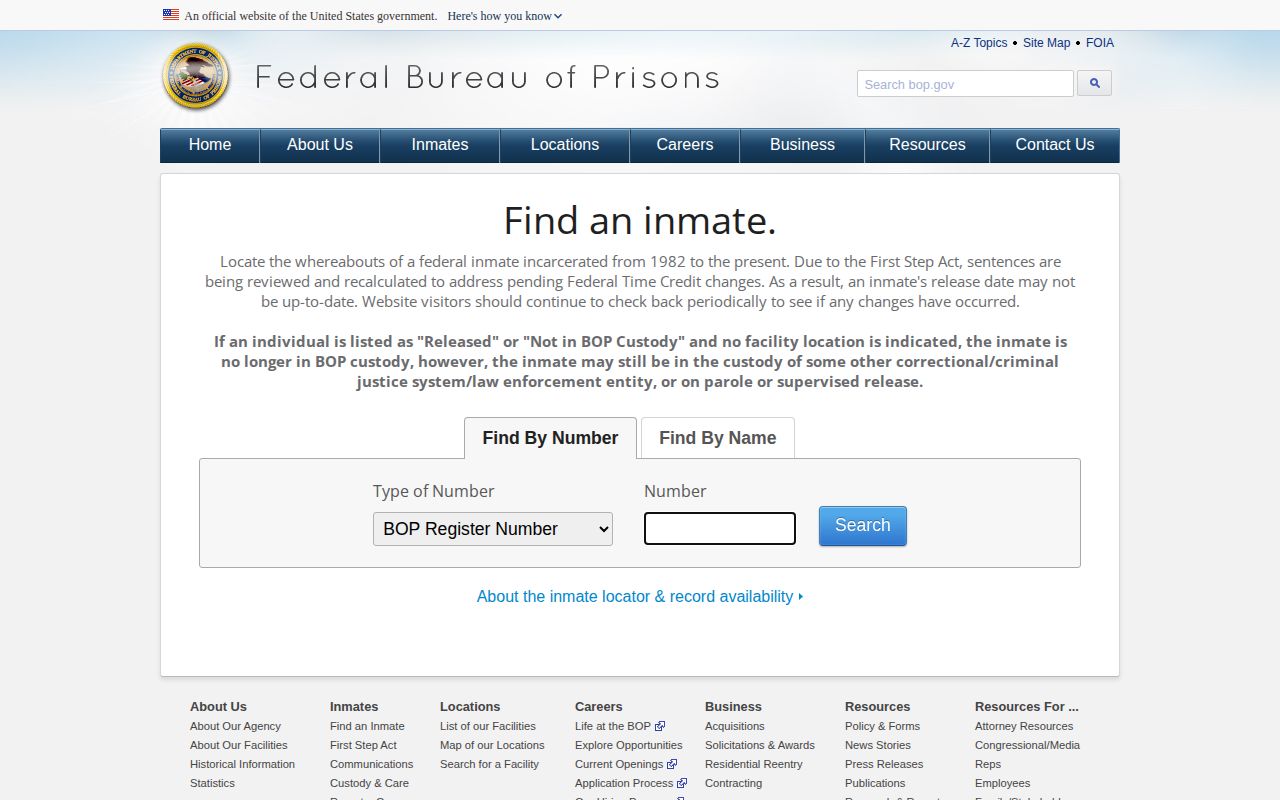
The locator can confirm departure from BOP custody, but jurisdiction checks remain necessary before describing a community release.
BOP Release Record Fields
A result can show the person’s name, register number, current age, race, sex, location, and release date. A past release date with no facility indicates that release occurred on the date represented and the person is no longer in BOP custody. “IN TRANSIT” has a different meaning. It can reflect USMS movement or a court release that has not yet been relayed back to BOP.
A Community Corrections Management label can refer to BOP-managed placement in a halfway house or home confinement setting. It does not automatically mean final sentence discharge. Likewise, a person can leave institutional custody and begin federal supervised release under the court. Use the docket and probation office for that separate status.
Federal Detainers After Release
BOP’s release statistics exclude departures to another custodial jurisdiction, such as a state sentence, treaty transfer, or ICE detention or deportation. That distinction matters for Cloud County. A person may complete one federal custody stage and remain physically held for another agency.
The federal Notice of Release and Arrival form distinguishes “Community” from “Detainer.” It can record the detaining agency and address, transportation, expected arrival, supervision jurisdiction, and proposed residence. A supervised person may be told to report within 72 hours of discharge, or within 72 hours after the detaining authority later releases the person. The form demonstrates why a BOP departure date is not always a community arrival date.
Ask the records custodian which destination was recorded. For immigration detention, move to the ICE locator. For a Kansas sentence, move to KASPER. For another county jail, contact that jail. Do not use BOP silence to answer a different agency’s custody question.
USMS Cloud County Transfers
The U.S. Marshals Service manages federal prisoner processing, housing, transport, safekeeping, and disposition. A federal defendant can be held in a state or local contract facility and moved among facilities without becoming a BOP sentenced prisoner. Leaving Cloud County at USMS direction is a transfer unless federal authority confirms release.
USMS does not offer a general public historical locator like BOP. Use the federal docket for the judicial order, counsel or the clerk for the case, and BOP after designation where applicable. Agency records may require a federal records request. USMS generally does not release prisoner mugshots due to privacy concerns.
A “not found” result in BOP can therefore mean the person is in pretrial USMS custody, was never designated to BOP, falls outside locator coverage, or has a data mismatch. It does not prove the person is free.
Older Federal Release Records
The BOP locator covers federal inmates released after 1982. Older federal prison research generally goes to the National Archives. Useful request facts include the person’s full name, birth date or approximate age, race, and approximate prison dates. Historic federal court files can also supply the sentence and later orders.
A BOP record may exist for a pretrial detainee, material witness, or civil-contempt commitment who never served a sentenced federal term. Read the basis of custody before calling a date sentence completion. The register number and docket are the best links between records.
Records can also change through corrections. Preserve the search date, spelling, identifier, and exact location wording. A screenshot or note of a public result is supporting evidence, while a certified record or docket entry carries a different evidentiary role.
Federal Release Record Contacts
The BOP locator is the public search route for sentenced federal custody. Federal court records supply legal authority, and the U.S. Marshals Service holds agency records for its own processing and transport. No federal prison address belongs in Cloud County because none was identified there.
Federal Bureau of PrisonsPublic access: BOP Inmate Locator
Use the person’s federal number when available. U.S. Marshals Service
Federal prisoner records and transport
No general public historical inmate locator
For the local starting event, call the Cloud County Law Enforcement Center at 785-243-8164 and ask for the release code and federal receiving agency. The Cloud County release record process explains how to request that Sheriff event.
Federal Custody Serving Cloud County
No federal prison was identified in Cloud County. The Federal Bureau of Prisons system appears in the facility map because a federal case or detainer can take a person out of the local jail. The page describes a statewide and national custody channel, not a local building.
The proper sequence is Cloud County Sheriff destination, federal docket, USMS where pretrial transport applies, and BOP where sentenced custody or historical release applies. ICE is separate civil immigration custody. Each record should be described only for the jurisdiction it covers.