
Cloud County Release Meanings
A Cloud County jail exit is an event, not one fixed outcome. Someone may post bond, receive recognizance, finish a term, obtain a dismissal, receive probation, or leave under another court order. Those events can return a person to the community. A move to the Kansas Department of Corrections, another county jail, the U.S. Marshals Service, or immigration custody ends the local booking but does not end physical custody. The Cloud County Law Enforcement Center holds the operational event. The Kansas district court holds the legal order. Each answers a different part of the question.
A live roster is meant to show current custody. A released person normally drops from it. Cloud County does not publish an official roster or historical release archive in the Sheriff navigation, so a missing name is especially weak evidence. It can reflect release, transfer, a court trip, treatment placement, a record correction, or a move into another system. Accurate release verification starts by asking what “left” means, then follows the custody destination.
Cloud County Release Paths
The release reason controls both the next record and the right search system. Cloud County has not published its code legend, so request the actual code and any existing legend instead of assuming the local wording.
| Path | Meaning | Best confirmation |
|---|---|---|
| Bond or recognizance | The person may return to the community while the case continues. | Jail release event plus bond order |
| Dismissal, time served, or sentence completion | The local court authority permits release, though another hold may remain. | Jail event plus signed court entry |
| Probation | Community release occurs under court conditions. | Sentencing order and supervising agency |
| KDOC transfer | County custody ends, but state imprisonment begins or continues. | Destination code and KASPER |
| Federal or ICE pickup | Another custodian takes control. | Destination code, federal order, BOP or ICE |
Does a bond order prove the person walked out? No. It proves legal authority or conditions. A hold, processing delay, or another custodian can prevent community release. Pair the court entry with the Sheriff’s actual release event.
Cloud County Release Record Fields
A release record is normally tied to a particular booking. Ask for existing fields, not a narrative the agency must create. The strongest local proof joins the door-out event to the court’s legal disposition. If a code is unclear, request the agency’s existing code legend. Not every field below is guaranteed to be maintained or open, but this wording lets the custodian find the relevant record.
| Field | What it can establish |
|---|---|
| Full name, alias, booking number | Which booking the event belongs to |
| Booking date and time | The start of that local custody episode |
| Actual release date and time | When Cloud County custody ended |
| Release type or coded reason | Bond, court release, time served, transfer, or another maintained category |
| Destination or receiving custodian | Whether the person entered another agency’s custody |
| Bond and associated charges | The booking and case context, where maintained and public |
| Booking photograph | The image associated with that booking, requested separately |
A VINE message is useful supporting evidence. Preserve its status and time. It is a notice, not a certified Sheriff record. A projected prison date is also not an actual release event. Court orders, holds, credits, and transport can change what happens.
Request Cloud County Release Records
Cloud County publishes a public-records route and an official request form. Direct a booking-specific request to the Sheriff or Law Enforcement Center because that office created the jail event. State that electronic copies are preferred. The form asks for contact details, a signature, a specific record description, dates, and the office believed to hold it.
- Identify the person, approximate booking date, known alias, case number, and booking number if available.
- Ask for the existing booking and release event, actual release date and time, coded reason, destination, and code legend.
- Request the booking sheet and photograph separately. A photo may be withheld even when basic release fields are open.
- Ask for segregable public fields if part of the record is closed, and request written legal authority for any denial.
- Set a cost ceiling and seek an itemized estimate before work proceeds.
Cloud County’s form says charges reflect actual costs estimated by the custodian. It requires prepayment when the estimate exceeds $50, and production waits for payment. Under K.S.A. 45-218, the agency must act as soon as possible and by the end of the third business day. Acting can mean giving the reason for delay and the earliest expected availability, not completing a large production within three days.
Cloud County Law Enforcement Center2090 Fort Kearney Road
Concordia, KS 66901
Jail: 785-243-8164
Call first to confirm the records custodian’s location and hours.
Kansas Law on Release Records
The Kansas Open Records Act begins with a policy of access, but it does not make every part of a file public. K.S.A. 45-219 limits charges to reasonable actual furnishing costs and permits advance payment. Current law supports an itemized statement and a discussion of ways to reduce a request when staff work is estimated above five hours or $200. Cloud County’s lower form-specific prepayment point still applies.
K.S.A. 45-217 excludes jail rosters and basic detention entries from the definition of criminal investigation records. Yet K.S.A. 45-221 contains exemptions for protected investigative, correctional, and private matter. Closed content generally should be separated from open content where possible. Booking photos have a separate limit because the law generally does not compel copies of pictures in the same way as ordinary records.
Cloud County’s public pages state no retention period for release events or photos. Ask promptly whether the record still exists. Kansas expungement can later change public visibility. Waiting periods depend on the offense and disposition, and a granted order is sent through justice agencies. Portal silence after an expungement does not prove no custody event occurred, and lawful access limits should be respected.
What Happens on Kansas Release Day?
KDOC publishes concrete state-prison release logistics. Remaining resident-account funds are addressed, transportation is arranged beforehand, civilian clothes are supplied, and parole reporting instructions are provided. A pickup driver must show a driver’s license. These are KDOC practices, not verified Cloud County Jail procedures. No official Cloud County source identifies set release hours, an exit door, a family waiting area, a weekend rule, or local property-return steps.
The Law Enforcement Center is staffed around the clock, and visitation appointment calls are accepted around the clock. Neither fact proves releases are processed at every hour. Call 785-243-8164 for the particular event and ask about pickup, property, identification, and where a waiting driver should go. Do not transfer KDOC rules onto the county facility.
Find Cloud County Released Inmates
Begin with the person and the booking, then test each likely custody route. The absence of an official recent-release feed means a named-person search works better than trying to browse a daily list.
- Collect the full name, lawful date-of-birth information, aliases, approximate booking dates, and case number.
- Search Kansas VINE for the Cloud County jail layer. Confirm the facility and preserve any custody-change status and time.
- Call the Law Enforcement Center. Ask whether Cloud County custody ended through community release or transfer.
- Search the Kansas district court case for the bond, dismissal, sentence, probation, remand, or later revocation entry.
- Use KASPER after a KDOC transfer, BOP for a federal sentence, or ICE for immigration custody.
- Request the Sheriff’s booking and release event when exact time, code, destination, or older history is needed.
The same sequence resolves older cases. Court records are often the durable legal trail, though sealed and expunged cases may be unavailable. A transfer may cross county lines. Search statewide when the arrest county, holding county, conviction county, and supervision county differ.
Where Did Cloud County Custody Go?
The Sheriff’s destination field is the handoff point. It directs the next search and prevents a transfer from being mislabeled as freedom.
| Recorded outcome | Next system | What that system adds |
|---|---|---|
| Community release | VINE and district court | Custody notice and legal reason |
| KDOC transfer | KASPER | State location, status, supervision, later discharge |
| Another jail | Receiving jail or county VINE result | Continued local custody |
| Federal pickup | Federal docket, USMS, then BOP | Federal authority and post-sentence history |
| Immigration transfer | ICE locator and ERO | Current or recent ICE custody |
USMS has no general historical public locator comparable to BOP. ICE’s locator has a short released-record reach, reported by ICE as the preceding 60 days. An old ICE non-result proves little. In all routes, “not found” must be read within the system’s scope.
KASPER Cloud County Release Search
The Kansas Adult Supervised Population Electronic Repository, called KASPER, covers people and cases connected to KDOC-operated or funded programs. It is not a Cloud County booking archive. Search by KDOC number when known. Otherwise use name and cautious filters, then match more than one non-sensitive field.
| Search field | Use | Limit |
|---|---|---|
| KDOC number | Best direct identifier | Must be known accurately |
| Last, first, middle name | Broad name search | Names collide and change |
| Alias | Find alternate names | Can broaden results |
| KBI number | State identifier filter | Not always known |
| Birth date or age range | Narrow a common name | Use only lawfully known data |
| Conviction or supervision county | Cloud can narrow relevant records | Those counties can differ |
A person record may show “Earliest Possible Release Date,” status, admission, location, custody level, photo, conviction rows, and supervision information. Preserve the exact displayed label. Parole, postrelease supervision, and conditional release mean prison exit into community supervision. “Discharged” is stronger evidence that the represented KDOC sentence and supervision ended. KASPER updates each working day, not continuously, and its community-corrections probation display has a post-April 21, 2021 gap.
The official KASPER entry and disclaimer shows the scope and update warnings:
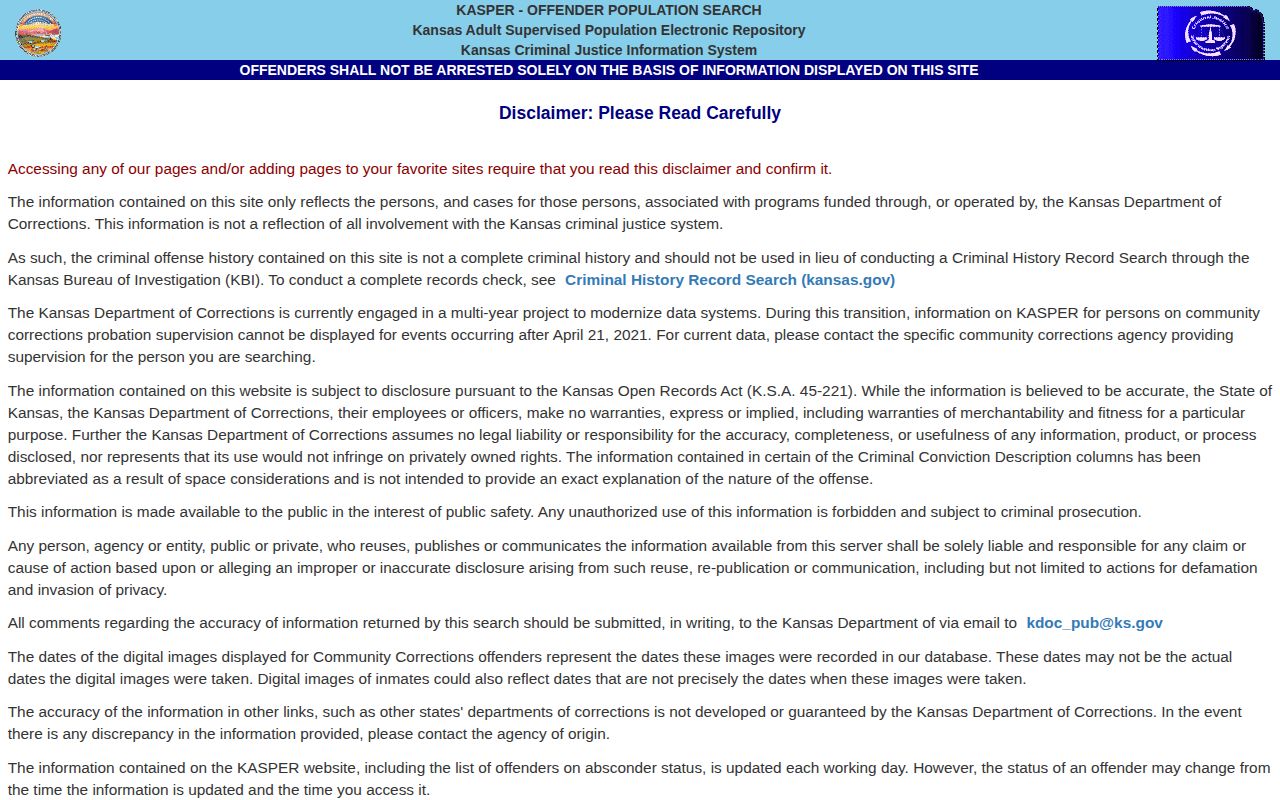
The disclaimer is part of the result’s meaning. KASPER is not real time, its photo date can differ from the date taken, and corrections go to kdoc_pub@ks.gov.
Cloud County Court Release Proof
Cloud County belongs to the 12th Judicial District, while the Kansas eCourt system supports statewide district-court searching. This matters when arrest, custody, conviction, and supervision occurred in different counties. Search the name, then confirm county, case number, filing date, and charge. Read available bond orders, dismissals, journal entries, sentences, probation orders, warrants, and revocation events.
The court docket explains legal authority. It is not a live jail door log. Conversely, the jail event can show the exact local exit without fully explaining the judge’s ruling. Reconcile both. If remote documents are unavailable, the Cloud County courthouse has a public-search computer, and a written court-record request may reach otherwise public material. Sealed, expunged, juvenile, adoption, grand-jury, and other protected records remain unavailable.
Cloud County VINE and Federal Checks
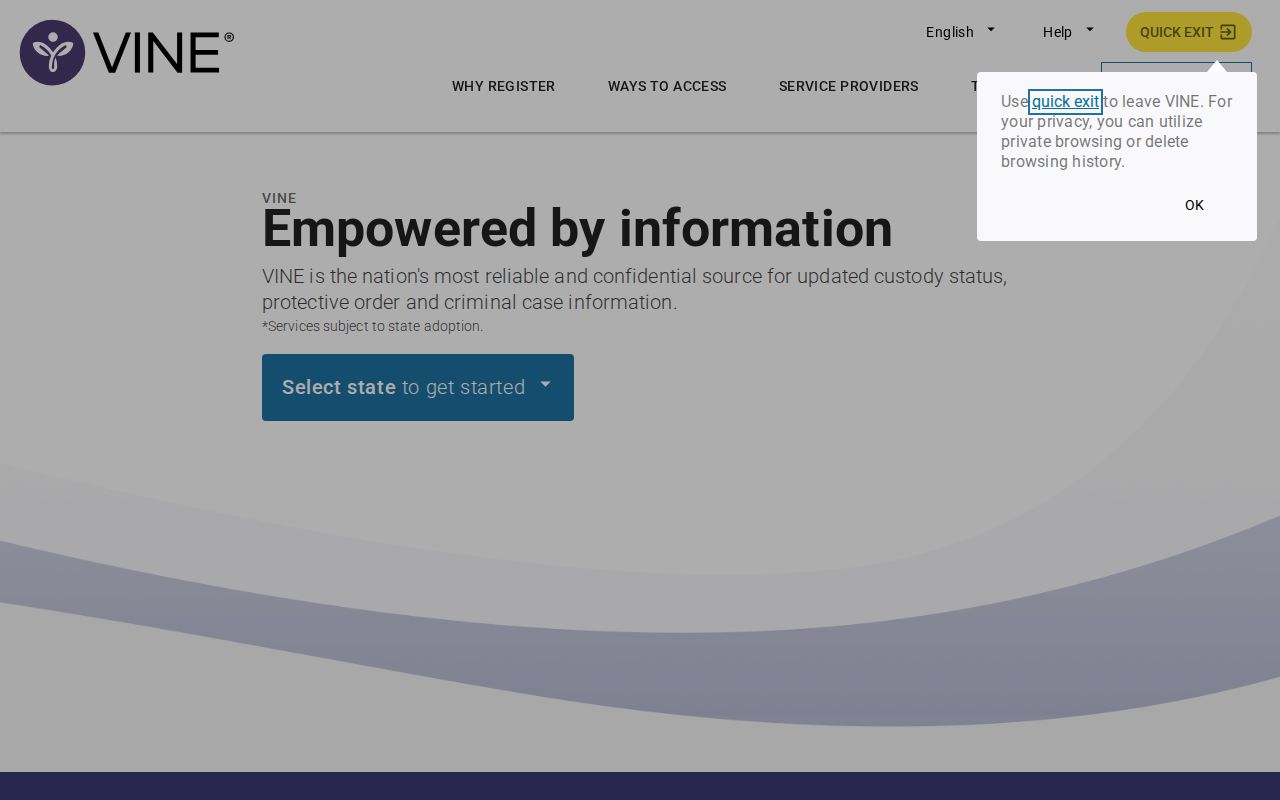
VINELink is the web entry for Kansas VINE. It covers Kansas county jails and expressly excludes KDOC prisoners. Search a specific person, verify the named facility, and register while the person is in custody for an offered phone, text, email, or app alert. A release, transfer, and escape notification describe different events. Confirm the exact reason and destination with the Sheriff.
The official VINELink interface provides the Kansas search and registration entry:
For a federal sentence, the BOP Inmate Locator can show a past release date and “Released.” That means no current BOP custody as represented there, but supervision or another jurisdiction may still apply. For immigration custody, use the ICE Online Detainee Locator. No official source established a dedicated federal or ICE facility at the Cloud County jail.
Cloud County Custody Status Sources
No one locator covers every Cloud County release. Match the question to the record keeper.
| Source | Best for | Cannot prove alone |
|---|---|---|
| Cloud County jail event | Actual local exit, code, destination | Later status in another system |
| Kansas VINE | County-jail custody change and alerts | KDOC prison status |
| District court | Legal disposition and orders | Exact physical exit time |
| KASPER | KDOC custody, supervision, discharge | Every Cloud County booking |
| BOP or ICE | Federal or immigration custody scope | All other jurisdictions |
Parole is supervised community status after certain prison sentences. Postrelease supervision follows many Kansas guidelines sentences. Probation is ordered by a court instead of, or after, confinement. Discharge generally marks the end of the represented correctional obligation. These terms should not be collapsed into “released.”
Cloud County Release Systems
Four custody systems can serve a Cloud County case, though only the first is a local physical jail. Each has its own release evidence.
- Cloud County Law Enforcement Center / Cloud County Jail: county booking, release or transfer event, and destination.
- Kansas Department of Corrections institutions: statewide prison placement, parole or postrelease status, and discharge through KASPER.
- Federal Bureau of Prisons system: federal post-sentence custody and released status through BOP.
- ICE detention / immigration custody: immigration detention and recent release within the locator’s scope.
The Cloud County jail’s recent audit reports designed capacity of 85, a current population snapshot of 44, and a 12-month average daily population reported as 48 in one place and 49 in another. Those figures are facility context, not release counts. The jail closed for more than eight months during renovation and reopened in July 2023. During that closure, agreements involved six other Kansas counties. A historical Cloud County detainee may therefore appear in an outside jail record, and that movement was not necessarily community release.