
Cloud County VINELink Coverage
Kansas VINE, short for Victim Information and Notification Everyday, is free, confidential, voluntary, and open to the public. The Kansas Attorney General describes it as a search and notification service for adults held in participating county jails. Cloud County is part of that county-jail layer.
The service does not contain people housed in Kansas Department of Corrections state prisons. It also does not replace the BOP locator for federal imprisonment or the ICE locator for immigration detention. That scope is central. A person leaving Cloud County Jail for KDOC has transferred custody, not necessarily reached the community.
The Cloud County Law Enforcement Center is the local source behind a county event. VINELink can deliver the status change, but jail staff and the existing release sheet can distinguish bond, time served, dismissal, a court-ordered release, and transfer. A participating service result should therefore be read as one layer of evidence. The jail event supplies operational detail, while the district-court order supplies the legal basis.
| System | Coverage | Correct use |
|---|---|---|
| VINELink | Participating Kansas county jails | County custody status and alerts |
| KASPER | KDOC programs | State custody, supervision, discharge |
| BOP locator | Federal prison records | Federal location or release |
| ICE locator | Immigration detention | Current ICE custody |
Search Cloud County VINELink
Search a specific person rather than trying to build a recent-release list. VINELink is a custody-notification interface, not a Cloud County historical roster. The official Sheriff navigation does not publish a separate county release archive.
- Open VINELink and choose Kansas.
- Select the people or offender search shown by the live interface.
- Enter the name or available identifier. Try a known spelling or alias if needed.
- Open the possible match and compare the facility plus available identifying details.
- Read the exact custody status and update time. Save the source and observation time.
A missing result can reflect spelling, lag, another county jail, or custody outside VINE. Call the Cloud County Law Enforcement Center at 785-243-8164 when the result remains unclear. The official VINELink entry begins the Kansas search.
When several people share a name, compare only the details needed to identify the right record. Facility is especially important. Avoid collecting unrelated personal data. If the known case concerns a state sentence, skip repeated county searches and move to KASPER. If the person was held for another county, the booking and release records may belong to that custodian even when the underlying case began in Cloud County.
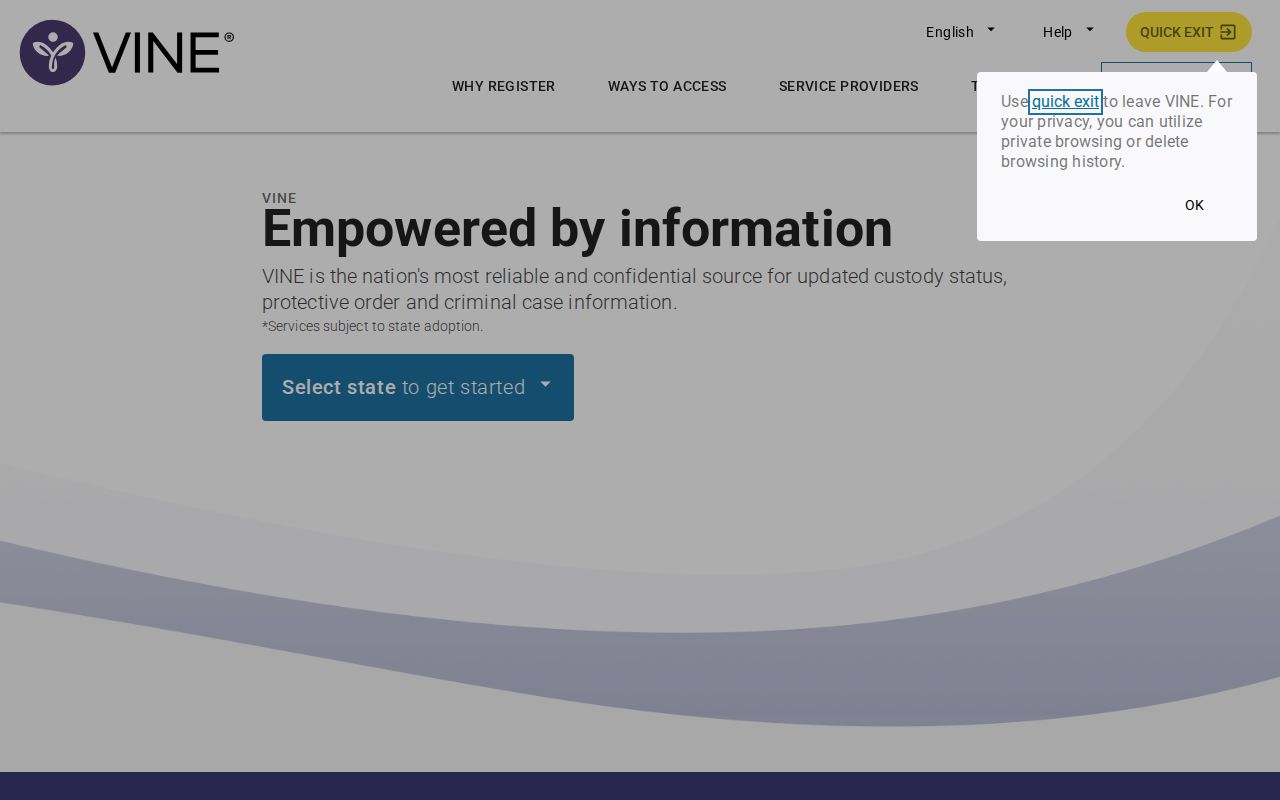
The captured entry screen starts a lookup, while the matched record and Sheriff event supply the person-specific meaning.
Cloud County VINE Result Fields
The live interface can change, and the participating jail controls the event data. Record only what appears. A result can help assess whether the facility match and status are plausible, but it is not the signed order or full booking sheet.
| Field | Meaning |
|---|---|
| Name or identifier | Starting point, not sole identity proof |
| Facility | Shows whether the result concerns Cloud County |
| Custody status | Must be preserved in its exact wording |
| Event type | May state release, transfer, escape, or another change |
| Event or update time | Service timing, not necessarily the complete jail record |
A VINE-reported release is a useful lead. The Sheriff’s release event is better for actual time, coded reason, and destination. The district-court record can show the legal authority.
Register Cloud County Release Alerts
Registration occurs while the matching person is in county custody. The live record may offer telephone, text, email, or app notice. Keep registration details private and verify the match first.
- Open the matching county-jail custody record.
- Select notification registration and an offered channel.
- For telephone notice, create a memorable four-digit PIN.
- When VINE calls, hear the full message and enter the PIN followed by the pound sign. This acknowledges the event.
- For email, the Kansas guide says no PIN is needed and one message is sent for a custody change.
The Attorney General also links VINEMobile. It is a statewide county-jail notification app, not a Cloud County Sheriff roster or permanent release archive.
A registration remains tied to the selected custody record and channel. Contact information is used for the notice, not to change the government record. If the call is missed, follow the current VINE instructions rather than assuming silence means no event occurred. A notification can arrive before a court portal reflects the latest filing, so save the wording and check both sources.
Cloud County Custody Event Limits
Release, transfer, and escape are not synonyms. A release event means county custody changed, but the destination still matters. Transfer means another facility or agency received the person. Escape is an unauthorized departure and must not be described as release.
If the person moved to KDOC, use KASPER. For federal or immigration pickup, use the matching locator. For a community release, compare VINE with the Cloud County booking/release sheet and court order. The Cloud County released-inmate search gives the broader cross-system route.
Kansas VINE is near-real-time, but not a certified historical record. The official Kansas sources also conflict on the toll-free number by one digit: the Attorney General page prints 1-866-574-7463, while its guide prints 1-866-574-8463. The guide lists TTY 1-866-847-1298. Verify the live page before calling.
VINELink to KASPER Handoff
Kansas draws a sharp jurisdiction line. VINELink covers the county booking, but the Attorney General expressly excludes KDOC state-prison offenders. When the Cloud County record says transfer to KDOC, stop treating VINE as the sentence tracker. Search KASPER by KDOC number or name.
KASPER can show state institutional custody, parole, postrelease supervision, conditional release, or discharge. It updates each working day. A weekend or holiday transfer may appear later. KASPER also has a stated gap for community-corrections probation events after April 21, 2021, so the court order and supervising agency remain important.
This handoff prevents a basic error: disappearance from the county-jail layer is not proof of freedom. The Sheriff’s destination code identifies where custody went next.
Confirm Cloud County Release Time
Ask the Sheriff for the existing booking/release record when an exact answer is needed. Identify the person and approximate booking. Request the actual release date and time, coded reason, and destination or receiving custodian if recorded. Ask for an existing code legend rather than asking staff to create an explanation.
Cloud County’s form says charges reflect actual costs and requires prepayment when an estimate exceeds $50. Request electronic delivery and an itemized estimate. Under K.S.A. 45-218, the agency must act as soon as possible and by the end of the third business day, though action may be a reason for delay and earliest production time.
Pair that event with the court docket. VINE tells when the custody status changed; the jail and court records explain what happened.
The official county site does not state how long a VINE event remains visible. Historical verification should not depend on finding an old app screen. A narrow request for an existing record is more durable and gives the Sheriff enough detail to locate the booking without being asked to research a person’s entire history.
Match Cloud County Court Records
VINELink reports a custody event, while the court case explains the legal path. Search the Kansas District Court Public Access Portal by name, then narrow the result by Cloud County, case number, filing date, and charge. Read bond orders, dismissal entries, sentencing journal entries, probation orders, warrants, and revocation events in sequence.
A court order can authorize release without proving that the jail finished the process at that moment. Conversely, a VINE event can report that county custody changed without explaining all terms of the order. Matching the two prevents a transfer, bond authorization, or delayed processing step from being mislabeled.
Some public documents may be available only through the courthouse terminal or a clerk request. Sealed, expunged, juvenile, and other restricted records are not public. Do not use unofficial mirrors to evade those limits. If the case is lawfully absent, the Sheriff can still answer a properly framed request for whatever release fields remain public.
Cloud County Non-VINE Custody
A Cloud County booking can end through transfer to another county, KDOC, federal authorities, or immigration custody. Each route needs a different record. The local release sheet should identify the receiving custodian if that field is maintained. Follow the named agency instead of making repeated VINELink searches after its coverage ends.
For federal imprisonment, the BOP locator can show a historical released status and date. It does not prove that state custody, immigration detention, or supervised release ended. USMS handles many federal pretrial moves but has no broad public historical locator comparable to BOP. The federal court order and agency records are the better path.
ICE’s locator concerns immigration custody and requires its own identifiers. A county entry that says release to ICE means Cloud County custody ended while physical custody continued. The distinction is why every VINE notice must be paired with the destination field before calling it community release.