
Kansas Corrections Release Paths
A person sentenced from Cloud County can be assigned to any Kansas Department of Corrections institution suitable for classification and bed placement. County of conviction does not identify the prison. When the person leaves Cloud County Jail for KDOC, the Sheriff’s destination field proves the local handoff. KASPER then becomes the public system for state placement, movement, community supervision, and discharge.
Leaving a prison can begin parole, postrelease supervision, or conditional release. Those are community statuses subject to state control and possible revocation. Discharge is stronger evidence that the represented sentence and KDOC supervision obligation ended. A move between prisons or to another custodian remains a transfer. The exact record must control the description.
| KDOC status | Meaning | Release effect |
|---|---|---|
| Incarcerated | Held in a state institution | No prison release shown |
| Parole | Older or indeterminate sentence released by Board decision | Community supervision continues |
| Postrelease supervision | Supervision after many guidelines prison terms | Prison custody ended, sentence control remains |
| Conditional release | Release under an older sentence structure | Community status can be revoked |
| Discharged | Represented KDOC obligation ended | Stronger completion evidence |
Confirm a Kansas Corrections Release
The Kansas Adult Supervised Population Electronic Repository, known as KASPER, is the public starting point. It covers people and cases linked to programs operated or funded by KDOC. It is not a complete history of every Kansas arrest and does not replace the Cloud County jail event.
- Accept the KASPER disclaimer and search by KDOC number when known. That identifier is more precise than a name.
- When using a name, check middle name, aliases, birth information, conviction county, and supervision county without collecting excess data.
- Open the correct record and preserve the exact current status, location, movement, sentence, and date labels displayed.
- Distinguish institutional custody from parole, postrelease, conditional release, and discharge.
- For an exact changing calculation, contact KDOC Sentence Computation through the locating contact instead of doing independent date math.
- Pair the KDOC record with the Cloud County court sentence and Sheriff transfer event when the full path matters.
KASPER updates each working day, not in real time. A Friday release, holiday event, correction, or late change can appear later. Its disclaimer also states that community-corrections probation events after April 21, 2021 may be absent during data modernization. Court-ordered probation should therefore be checked through the case docket and actual supervising agency.
The KDOC locating guidance explains why release dates change:
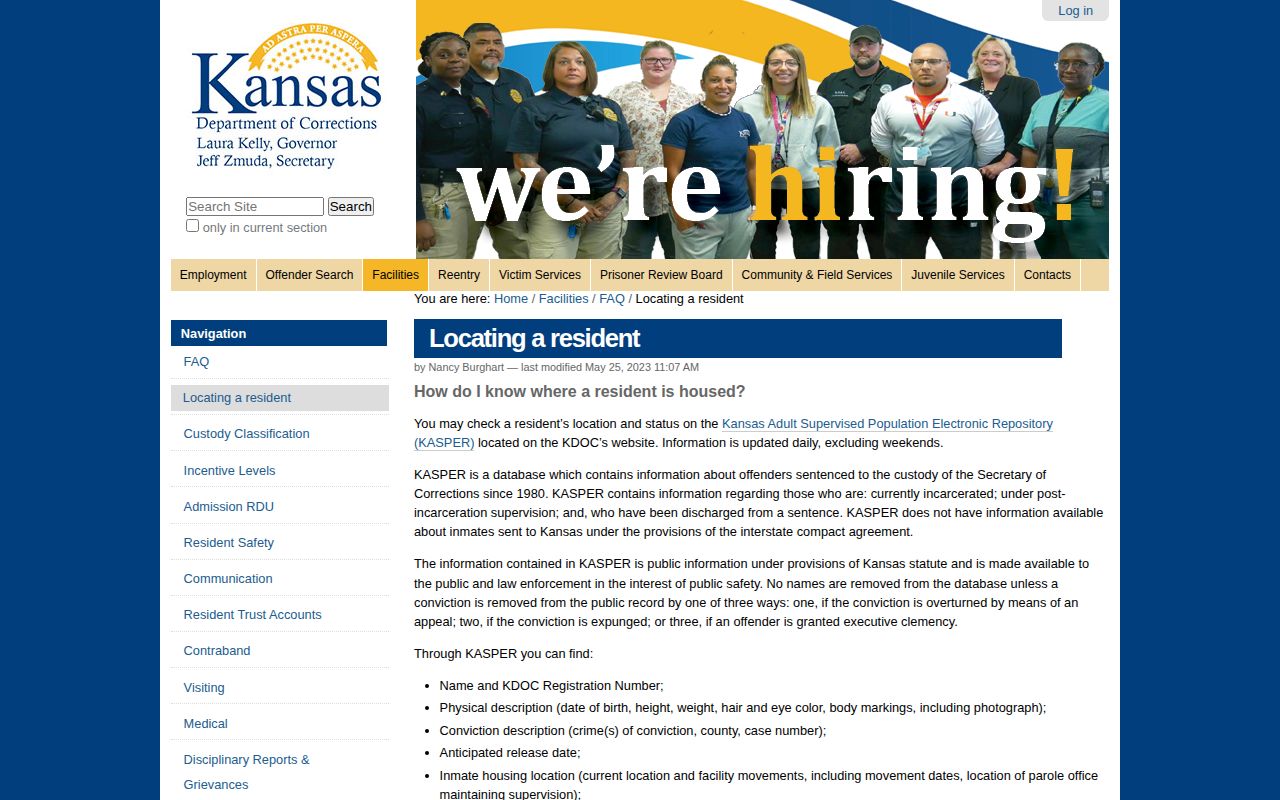
The state directs case-specific release date questions to Sentence Computation rather than treating a displayed estimate as final.
KASPER Cloud County Search Fields
The live form offers last, first, and middle name, alias searching, KDOC number, photo display choices, and advanced filters. Advanced options include KBI number, race, gender, birth date, age range, conviction county, and parole-supervision county. Cloud can be selected for either county field, but those counties can differ.
| Field | Best use | Caution |
|---|---|---|
| KDOC number | Direct person match | Enter accurately |
| Name and alias | Initial discovery | Names collide and change |
| Birth date or age | Narrow similar names | Use only lawfully known information |
| Conviction county | Connect the represented sentence | May not be current location |
| Supervision county | Locate parole oversight | May differ from Cloud |
A Social Security match field gives only a yes or no result. Name, KDOC number, and county filters avoid collecting such sensitive input. A photograph may help distinguish records, but KDOC warns that the image-recorded date may not be the day the photo was taken. Do not use the image alone as identity proof.
Kansas Corrections Release Date Labels
A live detail record may display “Earliest Possible Release Date.” Its note says a Prisoner Review Board decision or good-time and program credit can affect the date. Other records can show admission, location, custody level, conviction rows, supervision, or discharge. Not every record has every field. Copy the label exactly rather than converting every future date into a promised release date.
Kansas sentence structures differ. Many post-1993 determinate terms use a guidelines calculation, while older indeterminate sentences involve parole eligibility and a suitability decision. Eligibility only permits consideration. A Board result of parole is favorable, “pass” is a denial with later consideration, and “continue” postpones the decision for more information or deliberation. A hearing calendar entry is not proof that release occurred.
Kansas Good Time and Release
K.S.A. 21-6821 limits good time to 15 percent of the prison portion for many crimes committed on or after July 1, 1993. That rule produces the common “about 85 percent” shorthand only when the person qualifies for, earns, and keeps the maximum. It is not universal. Specified lower-severity crimes and offense dates can allow up to 20 percent, and current law permits up to 120 days of eligible program credit under stated limits.
Credits may be withheld or forfeited. For some sexual or sexually motivated offenses, time subtracted from prison can be added to postrelease supervision, so an earlier prison exit may not shorten the whole correctional obligation. K.A.R. Article 6 defines a guidelines release date using sentence start, prison portion, earned or awarded good time, and forfeited good time. The law in effect on the offense date controls.
Pre-July 1993 crimes use older rules, including statutory tables and parole eligibility. A simplified eligibility example cannot be applied as a guaranteed date. Sentence Computation at KDOC is the proper route for a person-specific answer.
Kansas Corrections Release Contacts
KDOC central contact routes release-date questions to Sentence Computation. Corrections to public KASPER fields should identify the KDOC number, disputed field, supporting order, and observation date. Cloud County parole cases can route to the Salina Parole Office North after KASPER confirms the supervision county.
Kansas Department of CorrectionsCentral telephone: 785-296-3317
KASPER accuracy: kdoc_pub@ks.gov Salina Parole Office North
919 E. Prescott, Suite 300
Salina, KS 67401
785-827-2584
The parole office does not supervise every person who bonds out of Cloud County Jail. Court services or community corrections may supervise probation. Verify the order and named agency first. Do not publish private reporting instructions.
Kansas Corrections Release Day
KDOC says remaining resident-account funds are addressed, transportation is established before release, civilian clothes are provided, and parole reporting instructions are given. A person who picks up the resident must show a driver’s license. These are statewide state-prison practices and should not be assigned to the Cloud County jail.
Release to parole or postrelease supervision still carries reporting duties. KDOC Parole Services supervises those state statuses and accepted interstate compact cases. A KASPER discharge marks a later and different milestone. The Cloud County release records path supplies the Sheriff and court records needed to connect the original county transfer to the later state outcome.
Where Cloud County Custody Went
The most useful decision begins with the Sheriff’s destination. A KDOC destination sends the search to KASPER. Another jail requires the receiving county record. A federal destination calls for the federal docket, USMS information, and BOP after designation. An ICE destination calls for the detainee locator. Community release calls for the jail event and court order.
KASPER cannot provide the exact Cloud County jail door-out time. Likewise, the local jail record does not prove a later prison release or discharge. Following each handoff prevents a county transfer from being mislabeled as freedom and preserves the scope of every record.